Inspired by the three big networks (ABC, CBS, NBC), banding together on Sept. 5th to air our televised show, we wanted to create that same kind of unity and movement online.
Thus, the Virtual Stand-Up, which will also take place on the 5th all day and anyone, not just network anchors, can get involved--bloggers, video podcasters, cancer research advocates as well as countless others online that are personally affected by the disease.
We all have the opportunity to show that everyone can stand up in their own ways by updating their Facebook or MySpace status to say "Stand Up To Cancer," on the big day, blogging about cancer and the need for research funds, twittering about SU2C, adding an email signature, etc.
If you're one of the few who haven't been following the story of Ben Teller through his "vlogs" (video + blog = vlog) over on SUTV, now's your chance to get caught up before he posts his last SU2C vlog today. Ben was diagnosed with Hodgkin's lymphoma as a teenager, but he's not letting that keep him from having fun - or from helping others. By selling $5 "cuck fancer" bracelets to help raise funds for cancer research, Ben really has, as he would put it, made cancer his bitch.
Check out Ben's vlogs here, and make cancer your bitch by donating to SU2C!
Ruh-roh. Right off the bat we've got some controversial news: a South African businessman thinks his cell phone is the cause of a newfound tumor near his right ear. He says at one point a few years ago his job required him to use his cell more than 50 times a day, adding that "the growth developed precisely where the middle of my phone is positioned when I talk on my cell phone." Yowza. (Share your thoughts on the cell phone issue over in the forums.)
In other creepy news, a Harper's article from April (we were slow on the uptake on this one) reports on the phenomenon of "contagious cancer," which is apparently spreading like crazy among Tasmanian devils in - where else? - Tasmania. "Cancers, like species, evolve," the article says. "And one way they can evolve is toward the capacity to be transmitted between individuals."
Can positive thinking improve cancer patients' odds of survival? Nope, says a real downer of a study in this month's issue of Cancer. Contrary to what many believe, the researchers found that a patient's outlook had no impact on his or her cancer. I guess that's good news for pessimists?
On a demi-related note, Cancer also has an article this month about complementary methods of treating cancer - CMs, to those in the know. New research shows that the vast majority of cancer patients use some form of CM; the most common were prayer/spiritual practice, relaxation, faith/spiritual healing, and nutritional supplements/vitamins. No word yet on whether the use of CMs improves survivorship, but one of the researchers did note that acupuncture has been shown to work, while vitamins are basically a total crock. What are some CMs you or your loved ones have tried? Did they seem to work? Share your experiences in the forums.
Popping vitamins in pill form may not have any impact on cancer, but new research does show that intravenous vitamin C shrinks tumors in mice. More research is definitely needed, but one day vitamin C might be a common supplement to more conventional, drug-based therapies.
If you've ever spent a week commuting between your bed and the bathroom thanks to salmonella poisoning, you're probably not interested in getting anywhere near that nasty little bacteria again. But salmonella could have uses beyond giving you a permanent aversion to Alouette cheese. (Fall of 2004 . . . I'll never forget that horrible week as long as I live.) Turns out tumors are one of salmonella's favorite treats. Oh, and don't worry - the version used by the researchers behind this study is totally non-toxic.
You know how much I love ending on a nice note, so here's your happy thought for the day. It's easy for adults to steel themselves for the misery of cancer treatment, but kids have a harder time processing the connection between today's pain and tomorrow's recovery. So a few hard-working folks at the University of Texas Health Science Center developed Re-Mission, which calls itself "an epic battle raging deep in the realms of the human body." Adorable and clever. Know of some other fun resources for kids with cancer? Share them with others over in the forums.
Just a little inside scoop from the Stand Up to Cancer production team.
We are now T-Minus 29 days from the show. Our production team is busy at work to make sure that the September 5th broadcast is as entertaining, educational, inspirational and, of course, "star-studded" as possible.
In the midst of working busily on the script for the telecast, we recently traveled to Chicago to film the big opening of our show.
I can't reveal too much but I can say that we were right behind the pitchers mound at U.S. Cellular Field with Lance Armstrong, Elizabeth Edwards and a group of amazing cancer survivors and oncologists.
It was such a rush! To hear the crowd cheering while standing near 2nd base at a Major League stadium is the closest I'll ever get to hitting a game-winning home run. Or a home run. Or at least a double. Or being a professional athlete.
Though I did get a White Sox hat, so maybe I'm on my way after all.
Make sure to tune in September 5th at 8pm for the big reveal of the footage we shot in Chicago.
After the Chicago trip, we rushed home to get even busier.
Every day since our return we've seen a rush of talent pouring in, from film stars like Jennifer Aniston, Casey Affleck, Meryl Streep and Scarlett Johansson to television stars like Dana Delany, America Ferrera, Masi Oka and Homer and Marge Simpson (you won't want to miss that one). There are more coming, and lots of surprises you'll have to watch the show to see.
So check back in and we'll keep you posted, and be sure to tune in September 5th. Things are really starting to ramp up.
Cancer kills more kids in the US than any other disease. This week SU2C co-producer Katie Couric and the ever-adorable Abigail Breslin were in Philly at the Children's Hospital of Philadelphia filming a segment for the big show. One of the kids they met, ten-year-old Pearce Quesenberry, is coping with a deadly form of brain cancer. She'll appear on the show with Abigail to tell America what it's like to be a kid with this horrible disease.
"People think 'Oh you have cancer it's really bad', but it's really bad. Like all the stuff you have to go through yeah. It's a lot," said Pearce.
She is getting experimental treatment. It's the kind of cutting edge research that Stand Up to Cancer may help pay for.
"Without funding you can't do experiments. Without funding you can't make discoveries. Without discoveries you can't deliver new cures to patients," said Dr. Tom Curran, Cancer Researcher at The Children's Hospital of Philadelphia.
Check out a video of Katie, Abigail and Pearce here.
With your help, SU2C will help create a brighter future for kids like Pearce. Be a part of the effort by donating now and don't forget to tune in on September 5 to find out what Abigail and Katie learned in Philly!
For the past 14 years I've felt guilty. Extremely guilty. And I need to get it off my chest. So here's my confession:
I cannot--for the life of me--remember what my mother said to me when she broke the news that she had just been diagnosed with breast cancer.
Most normal people can remember this. They remember being in shock, crying, long embraces. Me? Nothing.
Granted, I was in the 4th grade (do the math, I'm now 23) and I had just come home from school. I probably had some "big" news to share (of the multiplication tables or recess variety) and I couldn't wait for my parents to get their "little" talk over with so that I could go on and on about 4th grade things.
I was sitting on the edge of the bed (I can remember that much) and my feet didn't touch the ground. My dad was peering in from the doorway and my mom, well, she was right there in front of me.
Her words are like a blur, and as an adult who adores life's little details, I'm still trying to cope with my faulty memory.
Perhaps as a vibrant nine-year-old, the option of losing my mother didn't exist. She was a super-human. She was invincible. She was my very own superhero.
On top of my overactive imagination, there's a good chance that I didn't really understand what breast cancer could do to a woman--how it could steal her breast, her hair, her immunity, her confidence, her life.
Or maybe it was just a hunch that this woman I called Mom was pretty damn strong.
I think it was the latter.
But now that I think about it, I'm glad that I can't remember the "before." I do, however, remember the "after."
I remember her coming home from the hospital, bandaged and reconstructed. I remember making her do her exercises to regain her strength. I remember her graying hair as the chemotherapy set in. I remember forcing her to return the wigs she bought "just in case." That wasn't how I wanted to see my Mom. I didn't care if her hair was falling out. I wanted no cover-ups or lies. Just her, cancer free.
This year, I'm going to forgive myself for not remembering her words that fateful 4th-grade day. Instead, I'm going to focus on the now. My Mom is alive.
Last night, the Kitson clothing studio in West Hollywood, debuted the MUXO handbag collection designed by Brazilian born model Camila Alves (Matthew McConaughey's girlfriend). Camila has kindly selected Stand Up To Cancer as her charity and will soon be releasing a special SU2C handbag where a portion of the sales proceeds will benefit our organization. We'll keep you posted on this.
For those wondering what's MUXO? It means "Goddess of the Water" in an African language and that name is embossed into the leather of each of her rustic hand, clutch and travel bags. Each is hand crafted using the finest Brazilian leathers and hardware, for a glamorous look that is both elegant and casual.
The launch party featured Stand Up To Cancer signage, which stars like Perez Hilton, Camile Alves and Matthew McConaughey posed in front of:
If you're one of the few who haven't been following the story of Ben Teller through his "vlogs" (video + blog = vlog) over on SUTV, now's your chance to get caught up before he posts his last SU2C vlog today. Ben was diagnosed with Hodgkin's lymphoma as a teenager, but he's not letting that keep him from having fun - or from helping others. By selling $2 "cuck fancer" bracelets to help raise funds for cancer research, Ben really has, as he would put it, made cancer his bitch.
Check out Ben's vlogs here, and make cancer your bitch by donating to SU2C!
New as of 8/30:
Ben is now making his cuck fancer bracelets available for purchase at: cuck-fancer.com
Earlier this week Eric Shanteau swam in his last Olympic race before heading home, where he'll be treated for the testicular cancer he was diagnosed with two months ago. Though Shanteau didn't bring home any medals, he showed the world that cancer doesn't mean you can't chase your dreams. Good luck, Eric! Get better so we can see you kick butt in London in 2012.
This week cancer took another valiant athlete, although she didn't grab nearly as many headlines. The San Francisco Chronicle carries the story of Deb Mosley, who raced a triathlon, hiked in and out of the Grand Canyon and climbed Half Dome three times - all after finding out she had breast cancer. Even as the disease metastasized through her body, Mosley was out living life to the fullest. She was an inspiring figure who "not only owned her disease, she almost celebrated it."
There's been a lot of news recently about the risks and benefits of screening and treatment for various cancers. Patients and practitioners face a lot of tough decisions when the medicine is as brutal as the disease. This week, the NYT's Well blog on how early detection isn't always a good thing:
Meanwhile, MD Anderson Cancer Center has issued a study on the importance of risk assessment in long-term treatment planning for breast cancer patients.
What do you think about the idea that patients shouldn't be screened or treated for cancer if, statistically, the odds of extending their life aren't that great? Is this smart policymaking for an already overburdened health system, or is it abandoning patients when they're at their most vulnerable? Sound off on the topic in the SU2C forums.
Speaking of the Grey Lady, I was shocked by yesterday's story about the lengths some couples have gone to in order to keep each other insured. It's not unheard of for people to marry for health insurance; I've got a friend who kids around about it all the time. But what if you had to get divorced in order to qualify for low-income coverage? Our health care system is driving couples to do just that. Talk about violating the sanctity of marriage . . .
We know from past experience that promising new cancer treatments can come from unexpected places - like the tobacco plant. Well, here's another classic for the "WTF" files: Fred Hutchison researchers think scorpion venom may come in handy for treating brain cancer. I love a good underdog story.
Breast cancer is both the most infamous and the most famous cancer in the US. Sounds contradictory until you think about it - breast cancer gets the most press and the most attention, despite being statistically comparable to prostate cancer, its fraternal twin. Approximately 250,000 women will be diagnosed with breast cancer in 2008, while approximately 200,000 men will be diagnosed with prostate cancer, according to American Cancer Society stats. Around 40,000 women will die of breast cancer; around 30,000 men will die of prostate cancer. Both are leading causes of cancer deaths in this country. But only one has become a household word. Why?
My guess is that it has to do with differences between the genders. While both breast and prostate cancer affect people's very intimate personal regions, women in our society don't tend to be ashamed of talking about their bodies, especially when their health is at stake. Just last week I sat in the middle of the crowded SU2C office talking to a coworker about our gynecologists. We didn't think twice about comparing notes on everything from office décor to Pap smear technique. But I've never once overheard two men comparing their doctors' rectal exam methods in public, and I'd be surprised to hear it's a commonplace practice in private.
I know that as a woman it's easy for me to generalize, but I'm not the only one who's noticed that men are a little hesitant to even talk about prostate exams, much less get them. This 1999 Senate testimony from Bob Dole speaks to the same point:
People ask me how I can be so open about my own experience with prostate cancer. I must admit, when I first started speaking out about this disease there were plenty awkward moments. But, then I decided that the alternative -- silence -- can be deadly. So, when I am fortunate enough to be asked to testify before Congress on this issue, I do it.
After finally beating prostate cancer in 2003, Minister Louis Farrakhan issued a similar call to arms. In his announcement of the Louis Farrakhan Prostate Cancer Foundation he tailored his message specifically to black men, who are statistically more likely both to develop and to die from the disease:
"I realized that this disease was killing black men at terrific rates, and that as men, we are difficult in terms of allowing ourselves to be tested. But, my dear brothers, let me encourage you. In fact, I'm going to spend the rest of my days encouraging men in general, and black men in particular: don't wait."
And singer Harry Belafonte came right out and addressed the two is of prostate cancer that most men don't even want to think about, much less talk about - impotence and incontinence.
Yes, he had surgery to remove it. Yes, he had problems with incontinence "but, because I was tenacious about doing the [curative] exercises, after one year it no longer existed," he said. And yes, he and his wife still enjoy a level of physical affection that "unifies our lives" . . . Men were just too "macho," he said. "The prostate is something that attacks that central part of the male body that men are very preoccupied with. Somehow, any disorder there means your life is over, you can't be a man anymore, you are now something less."
All three prostate cancer survivors made the same point: that a little squeamishness over the affected area is no reason to risk losing your life to cancer - especially to a cancer that is nearly 100% preventable if caught early enough.
--Cat Vasco
***************************************
Are you a prostate cancer survivor? Connect with others over in the SU2C Forums!
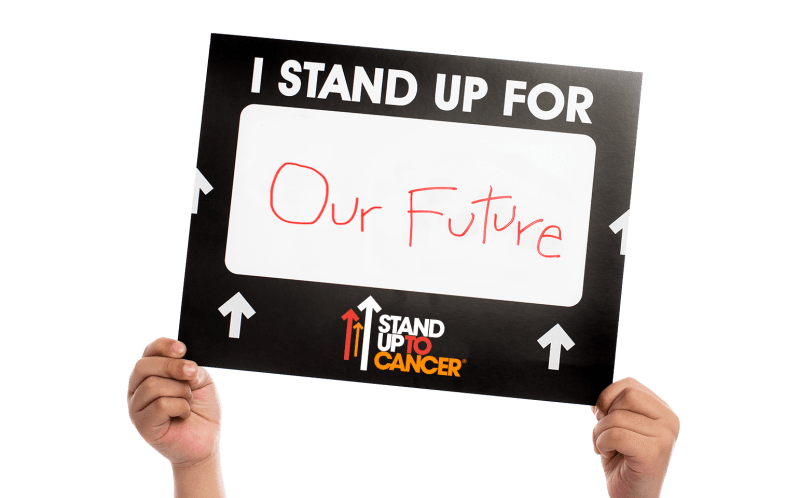
Have you seen the blogger donated video for Stand Up To Cancer yet? Over 30 bloggers and online sites donated photos of themselves holding signs that state why they are standing up to cancer, E.G. For my mom, hope, healthy boobs, whatever their connection to cancer is and why they are tired of this disease affecting their life and taking life. Thus, showing how all of us are affected by cancer. After all, no one is immune to the effects.
Besides the contributed photos, New York singer and songwriter Jennifer O'Connor, donated her song Sister, which is unfortunately based on her own cancer story.
I hope that everyone involved in SU2C, from you to me, are unwavering in our optimism and in our belief in what can be achieved if all of us affected by cancer (that's everyone) work together toward one common goal. This is hard, but it's also what's right: we can make cancer history. But sometimes, some weeks--and this happens to be one of them--we look around the news and are reminded of just how hard a problem we face, just how cruel this disease can be, and just exactly why we must work as hard as we can.
Since last Thursday, cancer has taken journalist Leroy Sievers, NFL hall-of-famer Gene Upshaw and John Challis, a Pittsburgh teenager whose diagnosis with terminal cancer at the age of 16 inspired him to live his life to the fullest in the time he had left.
Sievers, an NPR commentator and author of the My Cancer blog, passed away on Friday, seven years after he was initially diagnosed with colon cancer. "I don't think that the cancer is ever quiet," he wrote just a few weeks ago. "It always seems to be probing or looking, trying to find a place it can cause trouble." He was 53.
Upshaw lost his battle with pancreatic cancer on Thursday. Executive director of the NFL Players Association and a hall-of-famer thanks to his years playing with the Raiders, Upshaw was only 63.
In the two years following his cancer diagnosis, John Challis played for his high school's football and baseball teams, threw the first pitch at a Pirates game and spent a day with Yankees star Alex Rodriguez. "He was a very brave boy," A-Rod said. "Very smart. He had a huge heart. I was just proud that I got to spend a whole day with him . . . It's something that I'll be inspired by for the rest of my life."
With so many people still dying from cancer at unbelievably young ages, it's more imperative than ever that we renew our focus on finding a cure.
In other news, integrative medicine continues to strengthen its status as a legitimate part of the medical arsenal against cancer. Indian pharmaceutical company IPCA Laboratories is shifting its focus to ayurvedic, or biological, medicines, in hopes of commercializing a new approach to cancer treatment.
And in other drug news, remember when we talked about how turmeric has been shown to fight cancer? Well, now scientists are taking the next step - creating synthetic molecules from compounds based on the spice.
There's been a lot of conflicting information about the HPV vaccine recently, which is why I was happy to read this Slate article by Sydney Spiesel, MD, that breaks down common misconceptions about Gardasil. "The vaccine seems quite safe and very effective--especially when compared with the risks of not immunizing," he says. "I wish it were a lot cheaper. I also wish it could be given to younger children and to both boys and girls (both would get some benefit, though girls more)." Here's an idea: call it the cervical cancer vaccine, not the HPV vaccine. Then everyone's happy!
Since I started out with bad news, I'll finish on a cheerier note. As you may have heard, comedienne Christina Applegate is officially cancer-free after a prophylactic double mastectomy. And now she's using her influence to educate women on the power of screening MRIs and genetic testing. (Soundfamiliar?) "I'm going to have cute boobs 'til I'm 90," she said. Way to keep your chin up!
That's it for this hot August week, but we'll be back next Thursday with more required reading. Until then, generate some heat of your own over in the forums!
Why do we tell jokes? Do we do it in order to make the tedious bearable, to build community, to laugh at our lives, to reveal the ridiculous?
Isn't comedy a courageous examination, shining light on dark times? Why is humor called an invisible weapon? Is it because our sense of humor is like gravity -- a powerful force that cannot be observed directly by the five senses, but whose effects are consistent and undeniable? You can't see, taste, touch, smell or hear a sense of humor, but you sure can feel its effects. Whether you believe in it or not, it works! You don't have to believe in gravity. Just step off of a diving board and splash - you're wet. Likewise, you don't have to believe in the power of humor and laughter. Just start laughing and every system in your body acts as if a master switch has been turned in the direction of better health.
Listening to or seeing something really humorous can do many things for you. Just watch an episode of Seinfeld or listen to the thought-provoking antics of George Carlin and notice how good you feel. Start looking at your life and noticing the silliness around you as well.
There are many sites on the internet that are dedicated to humor and healing. One that has recently caught my attention is that of Saranne Rothberg, comedycures.org. Saranne was diagnosed with breast cancer in 1999. After her first bout of chemotherapy, she went directly to her nearest video store and rented every stand-up comedy tape she could get her hands on.
This motivated her to implement the power of laughter as part of her healing regime. Since her diagnosis, Saranne has created her own non-profit, Comedy Cures. It's an award-winning national organization that brings joy, hope and laughter to kids and grown-ups living with cancer, chronic illness, trauma, depression and disabilities. Through live events and digital outreach, Comedy Cures entertains and educates patients, families and care-givers around the globe.
You can tune in to The ComedyCures LaughingLunch Break Daily at 12:35pm ET on 1010 WINS-AM! Comedy Cures also has a laugh line at 1-888-Ha-Ha-Ha-Ha. You can call daily for an updated joke, or post your own.
One of Saranne's inspirations is the pioneer of therapeutic humor, "Norma Cousins." Norma is associated with the ideology of "Laughter is the best medicine." After all, laughter benefits the immune system and helps strengthen the mind-body connection. Laughter can be nourishment.
One of Saranne's visions is to "help you find joy in your journey." She and her organization are making a difference one joke at a time.
Helpful hints:
Take time each day to LAUGH, it is like oxygen for your soul.
Dare to be silly.
Rent a good comedy.
See the funny within your life.
Smile even if you have to force it, it changes the way you feel.
Go on, no one's looking, and even if they are, who cares? Just laugh for the sake of laughing. AHHH!!!!!! Doesn't that feel good?
-Yael Canavan, a proud member of the SU2C web team and a hearty laugher.
A big congratulations - and thank you - to the winners of SU2C's film challenge. We invited filmmakers all over America to focus their cameras on cancer, and the results were incredibly inspiring. Entries were judged by a panel of Hollywood luminaries including Laura Ziskin, Lauren Shuler Donner, Sherry Lansing, Greg Mottola, Julie Taymor and Robert Greenwald; their three favorites are, in ascending order:
Amanda Boggs is the creative force behind the choreography, direction and editing of this video. In this short, dance inspires people to come together and stand up to cancer.
In second place is a short that demonstrates the power of memory. "This film tells the tragic, unimaginable, and magical loss of my brother and sister to Glioblastoma Multiforme, the deadliest form of brain tumor," writes Justin Rubin. Check it out to learn what he means by "no next."
Jesse Ash's deceptively simple images (co-animated by Ryan Dennie) offer a child's perspective on loss. "Sometimes I dream of a magical cure," says the narrator. With SU2C's help, maybe that dream will come true one day.
A huge thanks, again, to all the talented filmmakers who submitted their work to SU2C, and congratulations to all our winners!
So Facebook, a prime time comedian, and a designer handbag walk into a bar...wait, what? Why would these three ever hang out? Is Facebook even old enough to be doing that type of thing? And is this joke headed in any direction at all?
Clearly the connection between these three facets of the contempo-life is not immediately recognizable. Sure, one makes friends, one makes fun, and one makes fabulous, but what is really important is that they each make up a part of the multi-tiered, ultra-diverse, super-varied arsenal of Stand Up 2 Cancer.
SU2C's cancer-fighting quiver boasts the widest and most targeted usage of popular practice ever seen. Specialty necklaces and online auctions will help save your mother from breast cancer. Social networking and autographed t-shirts will keep your brother from smoking. Yes, dozens of musical artists, scores of actors and actresses, and hundreds of entertainment professionals are all using the tools they love best to fight the thing we hate most--cancer! And so we target culture in the way we know best, in our chosen medium, and we fight cancer with what it often steals from us.
So please do keep in touch on Facebook, keep telling jokes, and keep shopping up a storm. Because cancer is nothing against a culture that loves what it can do rather than fearing what it can't. This is how we fight. This is how we stand. This is how we Stand Up To Cancer!
With just a week to go before the big show, SU2C is in the news more than ever. (Have you heard our awesome single? Seen the latest list of stars who'll be answering our phones?) But the real newsmakers are the people working every day to fight cancer. That's why I was excited to read about the researchers who've identified the gene that causes genetic neuroblastoma in babies and children. Their discovery will lead to genetic testing for worried parents, and hopefully to targeted treatments that will fight one of the most deadly childhood cancers. Now that's making cancer history.
September is Ovarian Cancer Awareness Month, so here are two news items, good and bad, on the women's cancer sometimes called "the silent killer." First the good: turns out plant-based flavonoids - known to you, me and Oprah as "antioxidants" - have been shown to cut ovarian cancer risk. So have a nice salad and toast your own good health.
Now the not-so-good news. A new blood test aimed at developing ovarian cancer early, while it's still treatable, has been available since June. But the Society of Gynecologic Oncologists, no lightweight in the women's cancer field, says the test has yet to be validated enough for routine use and can lead to unnecessary surgeries. "You've got industry trying to capitalize on fear," Dr. Andrew Berchuck, director of gynecologic oncology at Duke University, says in this NY Times article:
Speaking of women's cancers, here's good news for people who like good news. A new study from Israel shows that a sunny outlook can actually decrease your risk of developing breast cancer. "The results showed a clear link between outlook and risk of breast cancer, with optimists 25 percent less likely to have developed the disease," said the study's author. Smile - it could save your life!
http://www.5tjt.com/news/read.asp?Id=2981
Here's some interesting news from down under: an Australian survey finds that people are overly concerned about environmental cancer risks and not concerned enough about behavioral risks. In other words, blame your smoking before you blame your city's smog.
That's not to suggest that environmental factors can't play a major role, particularly when it comes to waste disposal sites, the likes of which abound throughout the United States. Two articles about Superfund sites on the East Coast caught my eye this week. Both areas were supposedly cleaned until they were safe, and both have proven deadly to residents. Really scary. (You can check to see if you live near a Superfund site here.)
Finally, let's turn our attention to a little meet-up in Colorado you may have been hearing about, the DNC. It's been all over the news this week, and I was really heartened to see Sen. Ted Kennedy back in action Monday night (even if it was against the advice of his doctors). "I pledge to you that I will be there next January on the floor of the United States Senate," he told the cheering crowd. "The hope rises again, and the dream lives on. My fellow Democrats, my fellow Americans, it is so wonderful to be here. And nothing, nothing is going to keep me away from this special gathering... "
When we check in next week it'll be just 24 hours to show time. Until then, though, there's plenty to read, watch and do all over su2c.org. Have a great time exploring and don't forget share your favorite stories of the week in the comments!